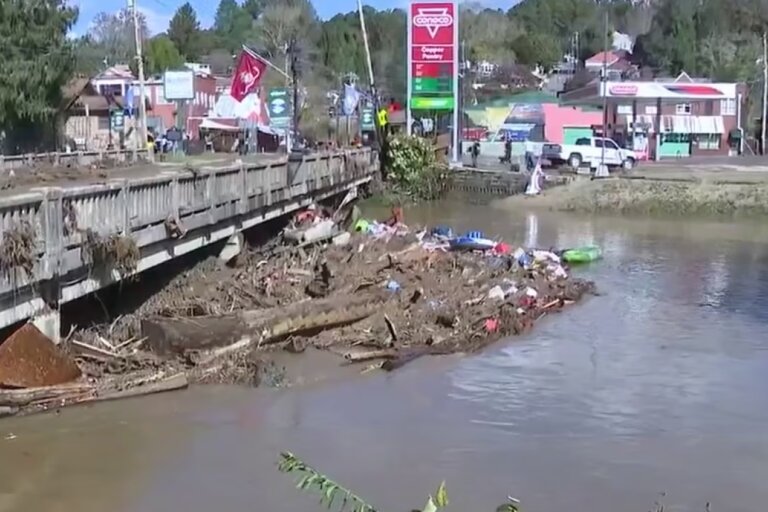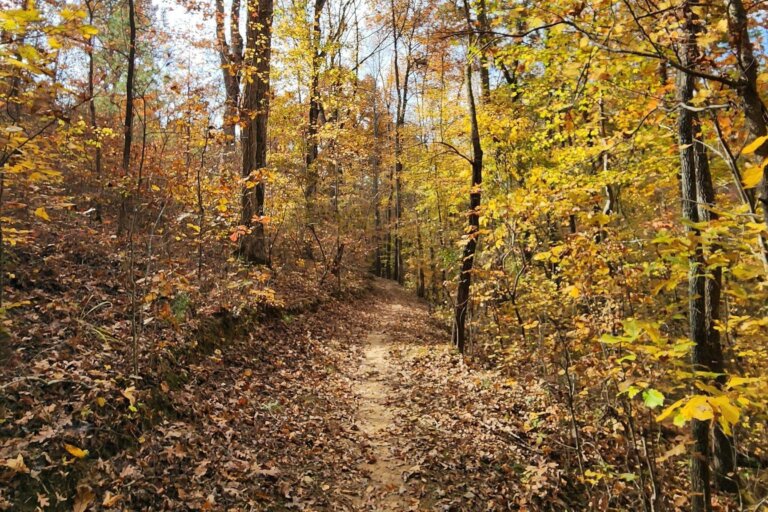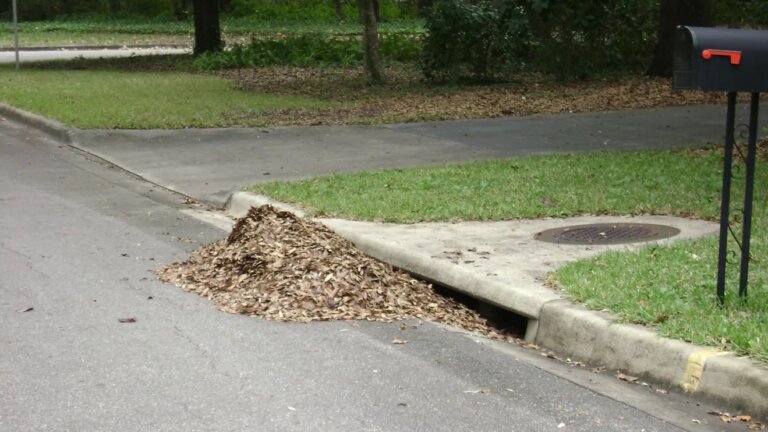
It’s that time of year in north Georgia: the hills turn gold and red, and then it all ends up on the lawn, the driveway, and the street. What happens to those leaves next matters more than most of us think. Leaves raked or blown into the street wash into storm drains, and storm drains don’t go to a treatment plant. They go straight to the nearest creek, and every creek in our watershed eventually flows into the Etowah.
Wait, Aren’t Leaves Natural?
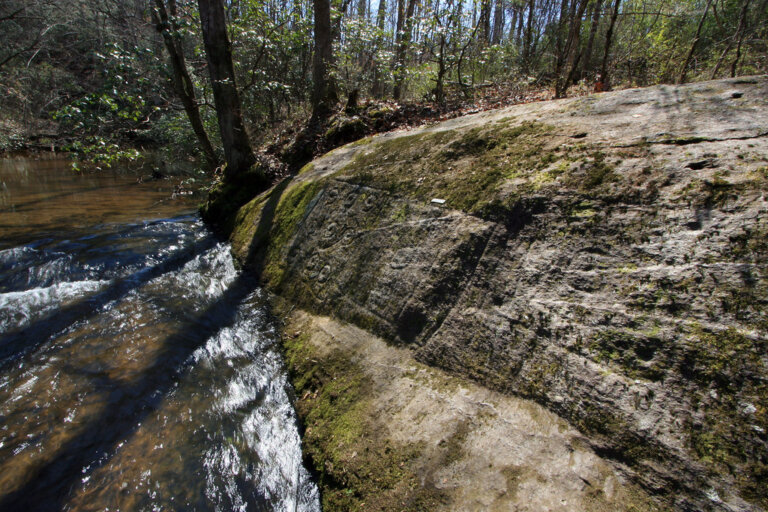
They are, and in the right place they’re essential. In a wooded stream, fallen leaves are the base of the food web. Aquatic insects like caddisfly and stonefly larvae shred them, and those insects feed fish, salamanders, and the crayfish of the Upper Etowah. Leaves trickle in slowly, a few at a time, and the stream can handle them.
Leaves in a gutter are a different story. Piled on pavement and soaked by rain, they steep like a giant pot of tea, releasing phosphorus and nitrogen. The next storm flushes that “leaf tea” through the pipes and into the creek all at once.
Why Too Many Nutrients Hurt a Creek
Phosphorus and nitrogen are fertilizers. In water, a sudden dose feeds algae. When the algae die and decay, the process uses up the dissolved oxygen fish and insects need to breathe. The result is murkier water and stressed wildlife, including sensitive species like our darters, which are found nowhere else on Earth. Downstream, those same nutrients build up in Lake Allatoona, a drinking water source for hundreds of thousands of people.
It adds up. A U.S. Geological Survey study in residential neighborhoods of Madison, Wisconsin, found that fallen leaves accounted for 56% of the yearly phosphorus in stormwater where leaves weren’t cleaned up. On streets where leaves were removed before rain, phosphorus loads dropped by more than 80%. Our trees and rainfall are different from Wisconsin’s, but the lesson holds: what happens on the street in fall shows up in the creek.
Leaves cause a practical problem too. Mats of wet leaves clog storm drains and ditches, which can back water up into streets and yards during a heavy rain.
What to Do With Your Leaves
Mulch them into the lawn
The easiest option is to skip the rake. Run the mower over dry leaves a couple of times until they’re dime-sized pieces. They’ll settle between the grass blades and break down over the winter, feeding your soil for free.
Use them in your garden beds
Shredded leaves make great mulch around shrubs, trees, and perennial beds. They hold in moisture, keep weeds down, and help rain soak into the ground instead of running off.
Compost them
Leaves are the “brown” half of a good compost pile. Mix them with kitchen scraps and grass clippings, and by spring you’ll have rich compost. UGA Extension’s Composting and Mulching guide covers how to get started.
Leave some for wildlife
A corner of the yard with leaves left in place gives shelter to overwintering butterflies, moths, fireflies, and the insects songbirds depend on.
If you bag them, follow local pickup rules
Many cities and haulers collect yard waste on set days. Check with your city, county, or trash service for how to bag or bundle leaves, and set them out close to pickup day so rain doesn’t scatter them.
Three Things Never to Do
- Don’t rake or blow leaves into the street, gutter, or storm drain. Ask your lawn service to blow leaves back onto the lawn or beds, not into the road.
- Don’t dump leaves or yard waste in a creek, ditch, or drainage swale. Even on your own property, piles at the water’s edge wash in with the first big storm.
- Don’t leave piles where water runs. Keep leaf piles and compost away from ditches, driveways that slope to the street, and the edge of a creek.
Give the Storm Drain a Hand
If there’s a storm drain in front of your house, take a minute after windy days and before a big rain to clear leaves off the grate (from the curb side, never by climbing in). Bag the leaves or toss them back on the lawn. It’s one of the simplest things you can do for your local creek, and it helps keep your street from flooding.
What About the Upper Etowah?
Our watershed is changing fast. As more of it becomes roofs, driveways, and roads, more rain runs off hard surfaces instead of soaking in, and more of what’s on those surfaces reaches our creeks. That’s the heart of nonpoint source pollution, the pollution without a pipe. No single yard makes the difference, but thousands of yards do. Healthy stream buffers help too, because a strip of trees and shrubs along a creek catches runoff before it reaches the water.
Our volunteer water monitors test creeks across the watershed every month, tracking the kinds of changes that runoff can cause.
How You Can Help
- Keep your leaves on your property and share this post with your neighbors, HOA, or lawn service.
- See a clogged drain, dumping, or muddy runoff? Report a problem, or find the right agency on our Who to Call page.
- Get involved. Volunteer as a water monitor, become a member, or donate to support clean water in the Upper Etowah.
Sources
- Selbig, W.R., 2016, Evaluation of leaf removal as a means to reduce nutrient concentrations and loads in urban stormwater, Science of the Total Environment, U.S. Geological Survey.
- U.S. EPA: Nutrient Pollution
- UGA Extension: Composting and Mulching (Circular 816)